
Team Daily/Weekly Target Leaderboards.
When creating a Daily Target challenge, an individual daily target leaderboard is created by default. You can create a team Daily Target challenge by following the instructions below.
Creating a Team Daily/Weekly Target Challenge
- From the Challenges (leaderboards) group in the admin console, select + ADD.
-
Select Daily/Weekly Target.
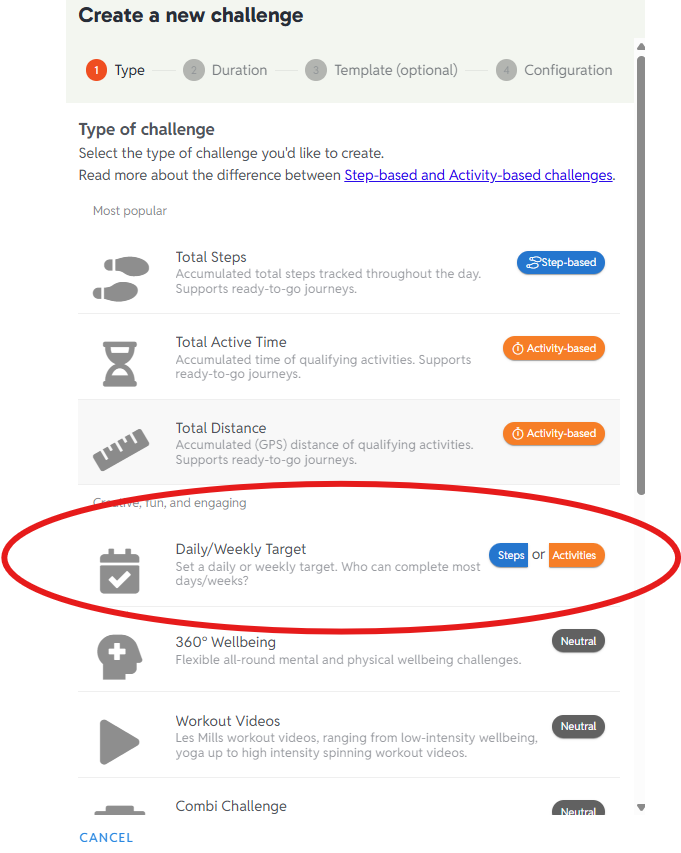
- Select the duration for your challenge.
-
Complete the other relevant data for your challenge.
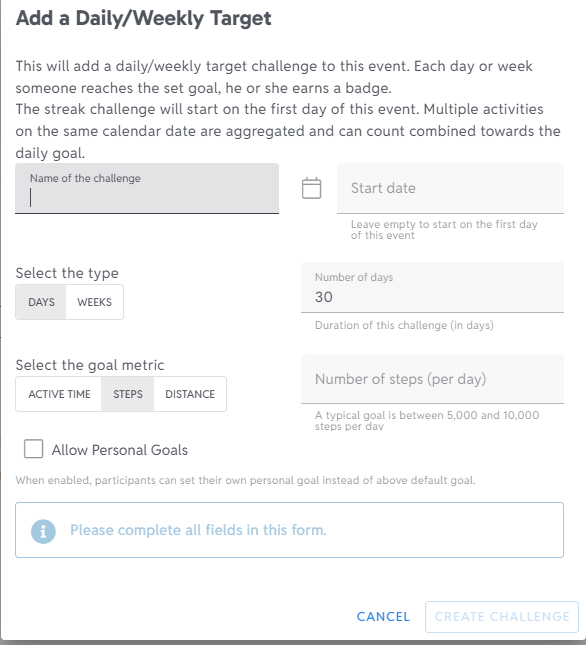
- Select CREATE CHALLENGE.
- A new challenge and leaderboard will be created. Select that new challenge in the Challenges (leaderboards) group.
- Select EDIT.
-
Select the Team group in the Edit challenge window.
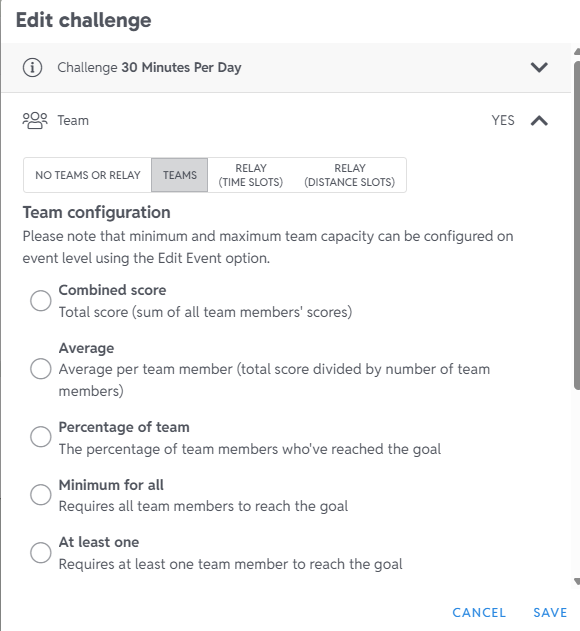
- Select TEAMS and your Team configuration. The rest of this article presents details about the configuration options.
- Select SAVE.
Your Daily/Weekly Target Team challenge is created.
Team Configurations
When creating a Daily/Weekly Target challenge for teams (like a step challenge), you can choose how team performance is scored.
Each configuration changes what “success” means for a team — whether it’s total output, fairness by team size, or all-in coordination.
This section explains what each configuration does, shows how two teams performed using the same data across configurations, and helps you choose the best mode for your organization.
Example Scenario
In this example, two teams are competing in a Step Challenge. Team Red has three members. Team Blue has five members. The step challenge lasts for three days.
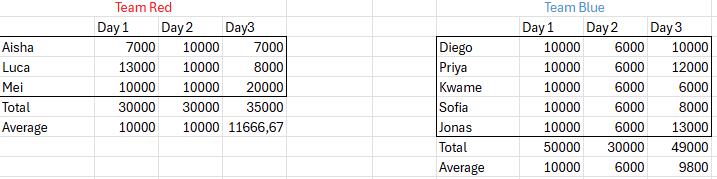
Here is how the two teams would be scored using each of the team configurations.
Combined score
Definition: Total score (sum of all team members' scores). All team members’ steps are added together each day.
If the combined total ≥ team goal, the team earns 1 point for that day.
If it’s below the goal, they get 0 points.
Goal: 35000 steps (total team goal per day)
Here is how each team fares using this mode:
| Team | Day 1 | Day 2 | Day 3 | Overall Score |
|---|---|---|---|---|
| Team Red | ❌ (30000) | ❌(30000) | ✔️(35000) | 1 |
| Team Blue | ✔️(50000) | ❌(30000) | ✔️(49000) | 2 |
Result: Team Blue wins (2 – 1)
Combined score is best for:
Teams of similar size, where you want to reward the total group output, and you are not concerned whether a few team members are pulling most of the weight. Combined score would not work very well for teams of various sizes. As in the example, it is very difficult for Team Red to achieve a daily goal of 35000 steps.
Average
Definition: Average per team member (total score divided by number of team members). Each day, the team’s average steps per member is calculated.
If that average meets or exceeds the daily goal, the team earns 1 point.
Goal: 10000 average steps per day.
Here is how each team fares using this mode:
| Team | Day 1 | Day 2 | Day 3 | Overall Score |
|---|---|---|---|---|
| Team Red | ✔️(10000) | ✔️(10000) | ✔️(11667) | 3 |
| Team Blue | ✔️(10000) | ❌(6000) | ❌(9800) | 1 |
Result: Team Red wins (3 – 1)
Average is best for:
Events with uneven team sizes since averaging levels the playing field.
High-performing and low-performing team members can skew scores for smaller teams.
Percentage of team
Definition: The percentage of team members who've reached the goal. Each day, the percentage of team members reaching the daily goal is calculated. These percentages are added together across all days. The team with the highest total percentage wins.
Goal: 10,000 steps per participant. Each team member who achieves the goal increases the percentage.
| Team | Day 1 | Day 2 | Day 3 | Overall % (sum) |
|---|---|---|---|---|
| Team Red | 67% (2 of 3) | 100% (3 of 3) | 33% (1 of 3) | 2.00 |
| Team Blue | 100% (5 of 5) | 0% (0 of 5) | 60% (3 of 5) | 1.60 |
Result: Team Red wins (2.00 vs. 1.60)
Percentage of team is best for:
Teams with uneven sizes where every member matters equally.
Great for encouraging universal participation and accountability.
Minimum for all
Definition: Requires all team members to reach the goal. The team earns a point only when every team member reaches the daily goal. If even one person falls short, the team receives no points
Goal: 10000 steps per participant
| Team | Day 1 | Day 2 | Day 3 | Overall Score |
|---|---|---|---|---|
| Team Red | ❌(2 of 3) | ✔️(3 of 3) | ❌ (1 of 3) | 1 |
| Team Blue | ✔️(5 of 5) | ❌(0 of 5) | ❌(3 of 5) | 1 |
Result: Tie (1 – 1)
Minimum for all is best for:
Teams that value full participation. One member’s miss affects the group. Ideal for close-knit groups or small teams where collaboration is key.
At least one
Definition: Requires at least one team member to reach the goal. The team earns 1 point if at least one member reaches the daily goal. Only one person needs to succeed. Additional achievers don’t add extra points.
Goal: 10000 steps per participant
| Team | Day 1 | Day 2 | Day 3 | Overall Score |
|---|---|---|---|---|
| Team Red | ✔️(2 of 3) | ✔️(3 of 3) | ✔️(1 of 3) | 3 |
| Team Blue | ✔️(5 of 5) | ❌(0 of 5) | ✔️(3 of 5) | 2 |
Result: Team Red wins (3 – 2)
At least one is best for: Encouraging daily engagement, celebrating small wins, and ensuring collaboration that at least one member of the team participates that day. At least one is perfect when you want to keep teams motivated and reward consistent effort.
Summary of Results
| Scoring Mode | Team Red Score | Team Blue Score | Winner | What It Rewards |
|---|---|---|---|---|
| Combined score | 1 | 2 | Blue | Total team output (balanced teams) |
| Average | 3 | 1 | Red | Fairness for uneven team sizes |
| Percentage of team | 2.0 | 1.6 | Red | Consistent daily participation |
| Minimum for all | 1 | 1 | Tie | Team unity and shared responsibility |
| At least one | 3 | 2 | Red | Consistent daily engagement |
Choosing the Right Scoring Mode
| If you want to… | Use this mode | Why |
|---|---|---|
| Reward total team effort | Combined score | Best when teams are the same size |
| Balance large vs small teams | Average | Normalizes for team size |
| Encourage consistent participation | Percentage of team | Rewards teams where everyone contributes regularly |
| Promote complete team collaboration | Minimum for all | Perfect for small, close teams |
| Encourage at least daily effort | At least one | Keeps engagement high even if only a few members succeed |
Admin Tips
- Set clear daily goals before the event — all modes depend on that baseline.
- For large organizations, try Percentage of team or Average to account for varying team sizes.
- For small or close-knit teams, Minimum for all creates strong collaboration.
- At least one works great for wellness campaigns that emphasize participation over perfection.
- Communicate to your participants how the scoring works.